“You said it could take 12 hours to travel 30 miles, and it just took us 12 hours to travel 30 miles.”
Before he said anything else, Jacob said, “You said it could take 12 hours to travel 30 miles, and it just took us 12 hours to travel 30 miles.”
Actually, we had traveled 35 miles in 12 hours to reach Dyngjufell Hut. But what’s five miles at that point?
I was wiped. The day seemed to have entire days embedded within it.
There were the easy, swooping miles of Jeep two-track curling through green grass, rutted, but still fast, with the occasional cut in the ground where we could get out of the wind and eat.
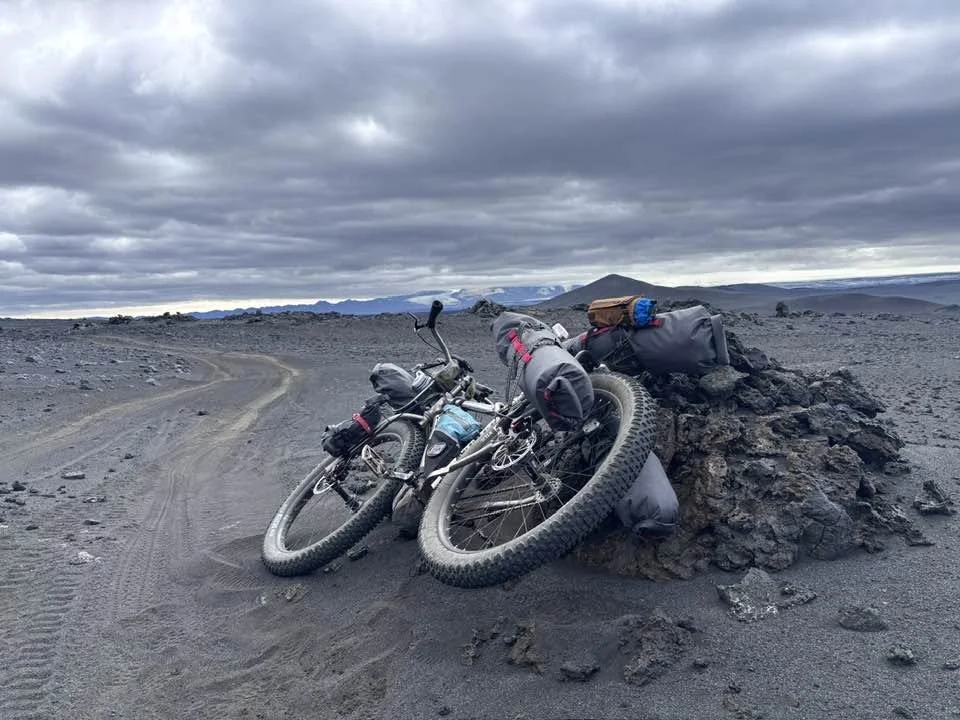
Then there was Ódáðahraun, the immense lava desert covering much of Iceland’s northeastern Highlands. The name translates roughly as “the lava field of evil deeds” or “the outlaws’ lava field.” Historically, it was associated with isolation, danger, and fugitives hiding in the Highlands.
That seemed about right.
Botni Hut, where we stopped and ate snacks for a while, lies near its northwestern edge. From there, the route to Dyngjufell Hut crosses roughly 16 miles of broken lava before entering Dyngjufjalladalur. It was mind-bending to cross, much of it on foot, following cairns and faint tracks through the rock.
This - and the next 250 miles- is my Iceland.
And finally, after six trips to Iceland, I got one: a sandstorm. In the video with Gary you can see the sand storm forming in the distance.
Gary pointed toward the horizon. There was no mistaking the approaching cloud. It wasn’t coming directly at us but moving across the route, growing as it went. We laid our bikes down, got on the ground, and pulled our Buffs over our faces. John, Brian, and Dan saw us lying there and sat down to take it in.
Before long, Gary and I were walking again, pushing our bikes into a 50-plus-mph wind from the west. We entered the cloud. Three miles and an hour and a half later, we came out the other side. I had become so accustomed to it that I didn’t immediately notice we were through.
It wasn’t until I lay down that night that I figured out why I had been seeing double through my left eye: I had two contact lenses in it. Of course I would make a hard day even harder.
As we approached Dyngjufell Hut, I realized that once again, just as in 2022, getting there had become a monster of a challenge.
I also knew it could have taken hours longer.
Thankfully, the day before, we had decided to add another 15 miles to the 30 we had completed by noon, getting ourselves to Goðafoss. That decision probably shortened the next day’s travel to Dyngjufell by three hours. In 2022, we hadn’t reached the hut until midnight, and we had our asses spanked.
The decisions each day, much like the decision to continue riding on that first day, July 22, were always less straightforward than they might appear.
I remember sitting at the park concession, eating a hot dog and running everything through my head. Getting more miles behind us would be good. But I also knew the wind would soon begin to take off and become a direct headwind. With our group, the next 15 miles could take as long as the first 30 and require considerably more effort.
I took stock of everyone’s excitement to finally be riding after months of preparation. I also considered that two people had chosen not to carry their gear that first day, leaving it in the truck with Mark. Usually, the first day of an expedition is when a person becomes acquainted with the load in the wind. I did not imagine Mark could make it in the truck the next day (but of course he did!) so they would need to carry their gear. Shortening the next day was a good idea all around.
We rode on.
The wind became a beast, probably approaching 45 mph. It is difficult for someone who hasn’t ridden in Iceland to imagine what the wind is like on a bike. People do not generally find pleasure in the masochism of pedaling a 70-plus-pound windblock into a headwind. On the plains, when those conditions occur, people simply avoid riding in them.
We eventually found what appeared to be a perfect windbreak: one of the hundreds of small churches spread across Iceland, about a quarter mile off the road.
No sooner had we set up than someone appeared and asked us to leave.
So we packed everything and moved on.
It was around 4:00 when we reached the church and probably 7:00 before we found our camp a couple of miles farther down the road, alongside a fast-moving river.
The extra 15 miles had not come easily on July 22. But the next day, somewhere in Ódáðahraun and the sandstorm, I was very glad we had ridden them.
Inside Dyngjufell Hut, Tom looked at me with concern and said something to the effect of, “I’m trashed.”
“I’m f@#$n’ trashed too,” I told him.
And I was.
He seemed hugely relieved to hear me say it.
I loved this day.
I loved the double vision, being sandblasted, pushing a 70-pound bicycle into a 50-mph wind. I loved being so tired that the final miles seemed almost abstract.
I loved the immensity of Ódáðahraun and the absurdity of trying to cross it on a bicycle. I loved following cairns through terrain. I loved watching the sandstorm form, and then getting up and walking into it.
I loved that the day asked everything we had and that I had enough.
I loved arriving at the hut completely trashed and hearing Jacob repeat back to me the warning I had given months earlier: it could take 12 hours to travel 30 miles.
This was precisely the Iceland I had come looking for. The immense, indifferent, astonishing Central Highlands that require something from you before it allows you through.